Minimum Security Standards for Identity Documents – Best Practice
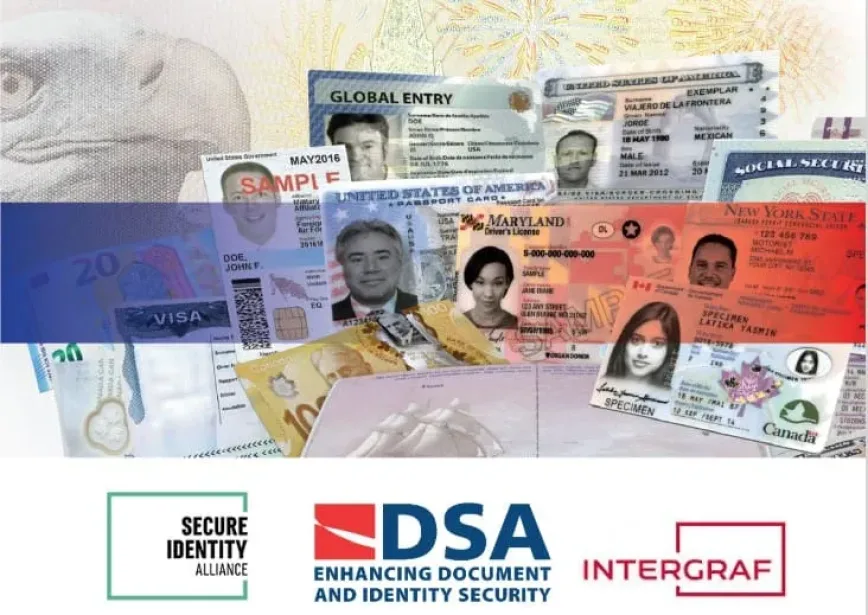
Best Practice Guidelines and Minimum Security Standards for Identity Documents – Recommendations for Advanced Document Design and Integration of Security Features – by Document Security Alliance, Intergraf and Secure Identity Alliance.
Raising the Bar: A Practical Framework for Elevating Minimum Security Standards in Government Identity Document Issuance
Identity documents — passports, national identity cards, driver’s licenses, and the many other credentials governments issue — are a critical element of modern global society. They enable people to prove who they are across a vast range of essential interactions: crossing international borders, opening bank accounts, boarding aircraft, entering government facilities, purchasing age-restricted goods, and countless other situations where trusted identification is a prerequisite for participation. In this sense, identity documents are not merely bureaucratic artifacts; they are the infrastructure of civic and economic life.
Of paramount concern is the alarming quantity, quality, and sophistication of counterfeit identity documents now pervasive across Europe, North America, and beyond. Fraudulent documents are instruments of serious harm: they facilitate identity theft, financial crimes including money laundering, worksite enforcement violations, and fraud linked to immigration-related offences such as human smuggling and trafficking. Manipulated and counterfeited credentials are also exploited by individuals connected to organized criminal networks — including international terrorist groups — specifically to reduce scrutiny from travel screening and border control measures. The threat is not abstract or distant. It is active, adaptive, and escalating.
Governments are continually under pressure to define security, technical, and design requirements that are both financially sustainable and genuinely effective — keeping their documents ahead of counterfeiters who are rapidly closing the gap. Drawing on a deep understanding of the technologies available to and actively used by the most sophisticated forgers, the authors of this paper aim to provide governments and document specifiers with best practice guidelines for the development and production of passports and identity cards that exceed minimum standards and are significantly more resistant to counterfeiting.
This paper is written for the practitioners and policymakers who bear direct responsibility for that resistance: the government officials, program managers, and technical leads overseeing identity document issuance. Its purpose is to raise the floor — to go well beyond the minimum standards. Not every issuing authority will adopt the same solutions, and not every context will support the same technologies. But every authority can aspire to a higher standard of security — and this paper aims to show what that looks like in practice.
What This Paper Is — and What It Is Not
This is not an encyclopedia of identity document technologies. It does not attempt to catalogue every available solution or provide exhaustive technical specifications. Instead, it is a practical guide to concepts, principles, and decision-making — focused on the “why” and “how” rather than the granular detail of every available option. Where technologies are referenced, they serve as illustrative examples of optimization rather than prescriptive mandates.
We acknowledge, plainly, that not all technologies are equal. Laser engraving, for example, offers a level of durability and tamper resistance that thermal personalization cannot match. Where authorities have the means and mandate to adopt superior technologies, they should. But we also recognize that procurement cycles are long, budgets are constrained, and transitions take time. For those authorities currently operating with less advanced systems, this paper offers guidance on how to extract the maximum security benefit from the tools at hand — and how to plan for future uplift.
Key Themes
Several themes run throughout this paper, each reflecting a critical dimension of modern identity document security:
- Advancing the Physical. The era of purely physical document security is behind us. Today’s strongest identity credentials integrate physical security features with embedded digital elements — cryptographic chips & codes, Machine-Readable Zones, and biometric data — in ways that
reinforce one another. This paper explores how issuing authorities can approach that integration thoughtfully, regardless of their current technical baseline. - Quality Control and Image Management. A document is only as secure as its weakest process. As an example, portrait photographs — the primary biometric identifier in most identity documents — are a frequent point of vulnerability. Poor image acquisition, inadequate quality checks, and inconsistent enrollment standards can undermine even the most sophisticated personalization technologies. Effective quality control over photograph capture and management is not a peripheral concern; it is foundational.
- Continuous Education as a Security Imperative. Technologies evolve. Threat actors adapt. Standards develop. No document produced today can be considered permanently secure against the threats of tomorrow — and no practitioner trained five years ago can be assumed current
without ongoing development. This paper therefore treats continuing education — through conferences, structured training programs, webinars, and peer exchange — not as an optional supplement but as an integral component of any credible security framework.
An Invitation to Raise the Standard
The recommendations and frameworks that follow are grounded in both established best practice and the practical realities facing issuing authorities around the world. They are offered not as criticism of current practice, but as an invitation: to examine existing standards honestly, to identify where improvements are achievable, and to commit to a trajectory of continuous improvement. The holders of identity documents — citizens, travelers, residents — place considerable trust in the authorities that issue them. That trust deserves to be honored with the highest standards of security that each authority can responsibly achieve. We hope this paper serves as a useful tool in that ongoing effort.