Addressing Cost Inflation in the Secure Identity Documents Ecosystem
The Case for Contractual Adaptability
DOWNLOAD STATEMENT: 26-11-12-SIA_Statement_Document_Inflation – Final
Recent figures publicly released by independent organizations have further evidenced the obvious growing inflationary pressures experienced along the supply chain of the secure identity documents ecosystem, from plastics to microchips, and from production to issuance to citizens.
These across-the-board inflationary pressures show no sign or receding. They are a reflection of structural evolutions, notably a demand for microchips multiplied by the massive development of data centers. Or they reflect sustained geopolitical tensions, notably for oil-derived plastics.
Stakeholders within the secure identity document ecosystem should be aware of these pressures that impact a key element of government sovereignty and of trusted access by citizens to public services. They should engage constructively, within their respective roles, to make sure that the production and issuance of secure identity documents is not compromised to the detriment of citizens.
The Secure Identity Alliance, an open platform for dialogue and progress between private and public industry and governments in the secure identity documents ecosystem, stresses that the production and personalization of secure identity documents is unlike any ordinary manufacturing process. Passports, national identity cards, and residence permits integrate engineered substrates, advanced electronic components, cryptographic systems, and specialized logistics into a single, certified product.
Every layer of this supply chain is currently under cost pressure:
| Electronic components and semiconductors. Sustained demand from the AI hardware sector continues to tighten global semiconductor supply, placing significant pricing strain on the contactless modules embedded in ePassports and eID cards — as well as on personalization equipment and IT infrastructure. [1] Traditional components are all the more under pressure than suppliers may chose to focus on higher-value, AI-related microchips, on top on a general increase of demand. [2] Compounding this, the ongoing conflict in the Middle East has disrupted petrochemical supply chains, constraining availability of helium — a natural gas byproduct critical to chip fabrication processes. [3] | 
|
| Plastic and polymer materials. Polycarbonate, polyurethane overlaminates, adhesive systems, and printing inks all derive from petrochemical feedstocks and are used in identity documents. The conflict in the Middle East has caused severe disruption to global petrochemical supply chains. Feedstock availability has tightened sharply, and polymer prices have risen sharply on public commodity exchanges since late February 2026. [4] |  |
| Paper substrates. Energy-intensive manufacturing processes have driven significant cost increases in security paper production, compounded, in Europe, by higher energy prices. [5] |  |
| Logistics and freight. Vessel rerouting around conflict zones, higher fuel costs, suspended operations at key transshipment hubs, and sharply repriced war-risk insurance have materially increased both inbound and outbound freight costs across the industry. [6] | 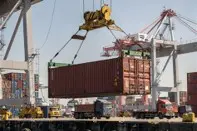 |
| IT infrastructures supporting issuance systems. From enrolment to personalization and issuance, governments design and procure robust IT infrastructures to sustain their operations, with support from industry partners. Some critical components, such as servers, are becoming significantly more expensive and harder to source due notably to the race for data centers. [7] |  |
In this context, the seamless provision of secure identity documents requires stakeholders in the ecosystem to be aware of these pressures and to address them constructively, within their respective roles, and depending on the specific situations they encounter.
Where they do not already exist, the inclusion of economic revision mechanisms, taking into account the reversal of cost assumptions and economic context that underpinned long-term agreements, may prove a necessary step to secure the stability and predictability of documents issuance, both in the short term and in the long term, as consequences may impact investment capacity, supply chain resilience, and the quality of sovereign identity infrastructure that governments depend upon.
More generally, in a context of renewed inflationary pressures, the inclusion of such mechanisms in future projects, as well as taking into account supplier resilience and supply chain risk management in procurement processes, may prove to be key to the sustainability of these projects.
Important
This statement is provided for awareness purposes only, and merely aims to highlight a general trend that may impact the stability of production and issuance of secure identity documents. Each member of the SIA acts in a fully independent manner with respect to all matters relating to their respective activities, from informing their own opinions to analyzing applicable legal/contractual frameworks, to taking any decisions vis-à-vis other stakeholders in their respective relationships.
Sources
[1] https://fred.stlouisfed.org/series/PCU33443344
[2] https://www.deloitte.com/us/en/insights/industry/technology/technology-media-telecom-outlooks/semiconductor-industry-outlook.html; https://www.weforum.org/stories/artificial-intelligence/what-is-chipflation-ai-hidden-price-tag/
[4] https://www.polyestertime.com/plastic-raw-material-prices-2026/
https://www.chinapapergroup.com/why-paper-prices-are-rising-global-market.html
https://www.freightperspectives.com/p/european-road-transport-contracted; https://unctad.org/news/hormuz-disruption-deepens-global-economic-strain-across-trade-prices-and-finance